03 March 2016

shame and vulnerability

“It is not the critic who counts; not the [woman] who points out how the strong [woman] stumbles, or where the doer of deeds could have done them better. The credit belongs to the [woman] who is actually in the arena, whose face is marred by dust and sweat and blood; who strives valiantly; who errs, who comes short again and again, because there is no effort without error and shortcoming; but who does actually strive to do the deeds; who knows great enthusiasms, the great devotions; who spends [herself] in a worthy cause; who at the best knows in the end the triumph of high achievement, and who at the worst, if [she] fails, at least fails while daring greatly, so that [her] place shall never be with those cold and timid souls who neither know victory nor defeat.”   ~ Theodore Roosevelt


Secrecy, silence, and judgement: the three ingredients that allow shame to thrive.
Empathy: the ingredient that douses shame.

With whom are you showing empathy? 
Who is showing you empathy?

08 December 2015

on seminary and tunnels

I came to Seattle Pacific University because of a direct call from God. I entered seminary because of a call. Yet what I’m learning is that a call is not a guarantee. You have to cultivate a call. You have to nurture it, pluck away the weeds from around it, water it, and protect it. But it’s worth it.

I thought that because I was called that I would love every second of it. But that hasn’t been the case. It’s been hard. There have been so many times where I wanted to quit, where I thought that I wasn’t going to make it. And to a certain extent, I still do. However, what I know to be true is that I’m not doing this alone. I have a crowd of witnesses around me, encouraging me and supporting me, cheering me on.

At SPU, one of the undergraduate traditions during graduation weekend is a ceremony called Ivy Cutting. It takes place in Tiffany Loop, one of the central locations on campus. Tiffany Loop is like a town’s “Main Street”, it’s an identifying marker of the school. All the graduating seniors gather in the middle of campus—far enough away from Tiffany Loop that it is not visible. The graduates then enter the ceremony along a sidewalk that leads into the Loop. But this walk is not the solitary walk of the formal graduation ceremony. No, this walk is crowded and noisy and wonderful. You see, the sidewalk leading into the Loop is lined with every professor and staff person. As the graduates walk, the professors and staff cheer and hoot and holler. This is a moment of celebration!

Tonight I was reminded of that ceremony in a conversation with one of my professors at the end of the class. We were talking about some of my struggles in seminary. He said, “You’re too valuable. We’re not giving up on you; and we’re not letting you give up on you.” Seminary is like that entrance into Tiffany Loop at Ivy Cutting. Yeah, it might be more like crawling than walking and the path may seem more like a climb up Mt Everest than a paved path, but it is lined with professors, staff, colleagues, classmates, friends, and family.

Often we use the language of tunnels to describe the timeline of a journey. The person who just finished the last quarter of classes is at the end of the tunnel. The person in the last year of classes can see the light at the end of the tunnel. I've gotten into the habit of joking that I'm in the middle of the tunnel with no end in sight, that there doesn't even seem to be an end. But my metaphor is missing a crucial piece. My tunnel is not a lonely tunnel. I have a crowd of witnesses attesting to the fact that there is an end and that I'm not alone. I am the one who has to walk the journey, I am the active participant in my story. But I am not alone.

21 November 2015

advent and the importance of the incarnation

In light of the Advent season nearly upon us, I've been thinking a lot about the importance of the incarnation. Advent is the time of waiting and preparing for Christ's second coming while also preparing to celebrate his first coming. So why does it matter if the Word became flesh, if God became God-with-us? Because it tells us something about who Jesus is, about who we believe in, and who we follow. I am reminded of this in my studies this quarter as we discuss how to approach youth ministry. Andrew Root wrote about the connection of youth ministry and the incarnation in his book, Revisiting Relational Youth Ministry: From a Strategy of Influence to a Theology of Incarnation.

"When the incarnation is discussed in connection to relational forms of youth ministry, it is often discussed as God's strategy or plan, making it possible for us to cut off the incarnation from the incarnate One. We often assume that being incarnate means being present in such a manner that we earn the leverage to influence others, as though God in heaven decided that incarnation was the best way to influence humanity. This position holds that God used God's humanity to convince people to accept God's message; it denies that the message itself is God's humanity. To think of the incarnation as a tool of influence is to deny the necessity of Jesus' humanity...It would have been just as well if Jesus only appeared human--he only needed to be human enough to influence. But Bonhoeffer has revealed that the incarnation is much more; it is not simply the strategy of God but the very heart of God for creation that opens the very being of God to humanity. If our humanity is to be transformed, we need a fully human God. We need a God who bears our reality and takes it fully into Godself. We need someone to accompany us (share our place) all the way to hell. Speaking of the incarnation as only of strategy for influence cuts free Jesus' humanity, making it possible for him to be only an idea, a logo, and not the who that encounters us within our human situation." (Chapter 4)

Jesus is the one who encounters us within our human situation. He is the one who encounters us in the middle of our relationship turmoil, our miscarriages, our academic studies, our oppression from systemic racism, our racialized society, our fears, and our comings and goings. This is who we are preparing to celebrate in Advent.

29 October 2015

when loving Jesus is not enough

An excerpt from The Adolescent Journey: An Interdisciplinary Approach to Practical Youth Ministry by Amy E. Jacober

"Most of my years as a student were spent being told, then reminded, then encouraged to ponder that God loved me and Jesus died for me. Discipleship and doctrines beyond salvation were mentioned but were not the focus. Spiritual formation and my responsibility toward this world and other people as a Christian were clearly not priorities. 
College didn't move me any closer to knowing the bigger picture of what it meant to be a Christian. I faltered around and did the best I could talking about Jesus while folding clothes at the Gap or praying with someone who just got dumped at an after-hours dance party.while I am sure my experience wasn't the case for everyone, I do not think it was as unique as I wish it was. 
Then I went to seminary, where I realized that while I could find Scriptures with a concordance, I lacked context or doctrinal understanding and the ability to think Christianly. I was embarrassed more often than not, but I finally decided it was better to be embarrassed and ask lots of questions than to keep playing the good Christian hoping I wouldn't get caught for how little I knew." (Chapter 1)

Practical theology is the intersection between human experience and theological reflection. We need to be practical theologians. We need to recognize that joining God in God's work of reconciliation in the world means living in that intersection. We need to acknowledge that "just love Jesus" is not enough.

18 April 2015

The Swamp

Not on my game
Thoughts floating
Mental swamp
Every thought takes twice the energy
Slow going.

How does one trek through a swamp?
Where does one learn how to swamp-hike?
It’s exhausting.
An energy drain.

It would be so much easier to just sit down in the swamp
To wait until the swamp dries out
To wait for the dry soil to return
Yet assignments and responsibilities are calling
Calling from the other side of the swamp
Calling impatiently for me to just finish

Don’t they see that there is a massive swamp between?
Don’t they see that “just doing it” requires more energy than I have?

Don’t they see that the slog is pulling me down with every step I try to take?

19 February 2015

yes please, writing, and spiritual disciplines

Recently, I have added "fun reading" back into my life. I've always been an avid reader but grad school has put a damper on that. However, since my epiphany about introversion, I have made an effort to read not-for-seminary books as a way of relaxing and recharging. Anyway, currently I am reading Yes Please by Amy Poehler. It is fantastic. She is very funny yet she is also refreshingly honest in what she writes. Why do I bring this up? Well, one, because I get to choose what I write about here and two, because something Amy wrote has stuck with me.

"Everyone lies about writing. They lie about how easy it is or how hard it was. They perpetuate a romantic idea that writing is some beautiful experience that takes place in an architectural room filled with leather novels and chai tea. They talk about their "morning ritual" and how they "dress for writing" and the cabin in Big Sur where they go to "be alone"--blah blah blah. No one tells the truth about writing a book. Authors pretend their stories were always shiny and perfect and just waiting to be written. The truth is, writing is this: hard and boring and occasionally great but usually not. Even I have lied about writing. I have told people that writing this book has been like brushing away dirt from a fossil. What a load of shit. It has been like hacking away at a freezer with a screwdriver." (italics added)

One of the hardest aspects of the transition from my undergraduate to grad school is the amount of writing. Undergrad has a mix of objective exams with multiple choice, true/false, or matching questions and essays of varying lengths. While not every class has an equal balance of the two, the overall ratio of objective exams to essays in undergraduate work ends up being about equal (at least in my experience). Grad school, on the other hand, is all about the writing. Nobody cares about objective exams; the bulk of the work is forming opinions about the material we are studying. It is a challenging transition to make when I naturally excel at objective exams and am not the world's quickest writer. It is a whole lot harder to type words out onto a page than quickly remembering details about this or that theory. I think this is why the excerpt above has stuck with me. It's my reminder that this is hard for others too, that I'm not alone in struggling to write at times. 

A recent blogger who I started reading this week wrote a post that compared parenting to spiritual disciplines. She writes, "I think the work of parenting--the often mind-numbing, eyeball gouging work that can somehow wrack me with worry and bore me to tears in a matter of minutes--is like a spiritual discipline because it is what we do, again and again, like it or not, to form us into who we hope to be." It got me thinking. What if I began to look at writing as a type of spiritual discipline? What if I looked at the struggle of writing as the struggle of a discipline? Does that change how I approach writing? I think it does change things. For starters, it gives me freedom to not write the perfect essay for each assignment. I can't seek perfection in my writing, rather I have to look at writing as a practice that I do over and over and over again. And every once in a while, there will be those moments where I write something great but most of it won't be and that's okay.

So now what? How do I get from this new approach of writing as a spiritual discipline to actually writing what needs to be written? I remind myself of another piece from Amy:

"So what do I do? What do we do? How do we move forward when we are tired and afraid? What do we do when the voice in our head is yelling that WE ARE NEVER GONNA MAKE IT? How do we drag ourselves through the muck when our brain is telling us youaredumbandyouwillneverfinishandnoonecaresanditistimeyoustop?
Well, the first thing we do is take our brain out and put it in a drawer. Stick it somewhere and let it tantrum until it wears itself out. You may still hear the brain and all the shitty things it is saying to you, but it will be muffled, and just the fact that it is not in your head anymore will make things seem clearer. And then you just do it. You just dig in and write it. You use your body. You lean over the computer and stretch and pace. You write and then cook something and write some more.You put your hand on your heart and feel it beating and decide if what you wrote feels true. You do it because the doing of it is the thing. The doing is the thing. The talking and worrying and thinking is not the thing. That is what I know. Writing the book is about writing the book."

It's time to stop thinking and talking and worrying about the thing. It is time to, in the words of the Nike slogan, just do it. 

13 February 2015

personality, epiphanies, and the church


I took the Myers-Briggs Type Indicator for the first time when I was about 10 years old. I’m not sure that researchers have studied the accuracy of the test for children but whatever the case, I remember getting ESFJ.

Fast-forward about ten years, and I took it for the second time. By this time, I knew more about the test itself and had some ideas about my personality; or at least, I knew that the first letter referred to either extraversion or introversion. By this age, I was aware that people were extremely important to me and I figured this meant that I was an extravert. Back to the MBTI, the second time I scored as an ENFP. This time, I read the description and felt it moderately described what I knew of my personality; it was not a perfect fit but it was pretty close.

Then this weekend happened.

It all started with this hobby of mine. You see, I like to understand people. I like to understand what makes people tick: why this person responds in this way and that person responds in that way. I enjoy reading different articles and books about personality psychology because it helps me better understand the people in my context. However, this weekend, my hobby took me to uncharted territory.

I found an article on Huffington Post about introversion. I have a number of friends who identify as introverts so I enjoy reading about introversion to help me understand their experience of life. Well, it was going fine and dandy until I had an epiphany. The person that the article was describing with these classic signs of introversion was uncomfortably similar to myself. 

Could I be an introvert?

So, I did what any good scientist would do and went back to the beginning of the article and read it closely analyzing each trait that was mentioned while frantically wracking my brain for experiences in my life to both prove and disprove each sign. I got to the end of the article and realized the shocking news: I mostly likely was an introvert.

How could I have lived my entire life without knowing this rather large detail about myself? How could I be a self-proclaimed people person and be an introvert? Surely, I was mistaken.

I spent the next 48 hours poring over different articles on introversion and extraversion, tentatively asking my very close friends for their opinions on the idea, and reflecting on past experiences in my life. At some point during that time, I decided to try something with the MBTI: I took it for the third time. This time I got INFP. Again, I read the description; only this time, it was like having someone hold up a mirror to my face. I was reading about myself!

Somewhere between seeing that mirror and having a couple friends exclaim that they had seen me as an introvert already that I accepted the truth: I was and am an introvert. This is both freeing and scary. I’m in uncharted territory. It’s like I’ve been painting the canvas of life with what I thought to be the color fire engine red only to discover that I’ve been painting with robin’s egg blue this whole time.

In one of my classes, Global Christian Heritage II, we have spent a lot of time talking about sacraments, worship style, and spiritual practices throughout our Christian history. We debate various methods of evangelism and the complications of imperial Christianity in other countries.

This week, as I live my life for the first time as a conscious introvert, I am struck by how much extraversion is rewarded in Christianity. We affirm the communal aspects of life so much that the private aspects of our faith are pushed to the margins. We push community groups; we invite people to meet-and-greet during worship services; we play music that is highly stimulating with drums and electric guitars; we honor the friendly, energetic volunteer in front of the congregation. These tasks all reward the extravert.

Where in our faith do we leave space for introverts? Where are the quiet times in our services? How are we supporting the diversity of personalities in our brothers and sisters?

My epiphany this weekend about my own introversion has raised a lot of questions that I hope to explore further as I grow in my understanding of my self. I also see a need for the Church regarding this. Maybe I can help create that space and recognition that introverts matter in the Church.


*This post was originally written for a reflection for a Practicum class. 

02 February 2015

when it becomes too personal

There are times when the material that one is studying becomes personal.

There are times when the scripture passages that one is studying become intensely personal.

There are times when you leave class completely raw because the material hit too close.

There are times when you just want to curl up in a ball and let the tears flow.

There are times when you aren't sure if you can do this because it's too personal.

There are times when all you have is raw pain and too much emotion.

Tonight is one of those times.

I wish I could find some way to neatly resolve the pain. I wish I could not feel the pain or at least find a way to separate it from the rest of my being. I wish I could delete these memories from the memory bank. Why do I have to deal with the gray of ambiguity? Why can't I turn off the memories of shame and helplessness and guilt? Why am I still raw so many years later? Will it ever end? I don't know the answers. And to be completely real, I probably never will.

For tonight, I'm going to be raw, emotional, and let the pain flow over me.


13 October 2014

archery and interpreting scripture

Just a point to preface this post, this is a reaction to one of my seminary classes. It's roughly written, it is not meant to be a finely tuned final draft. Rather this is a rant about a topic about which I am passionate, one that I needed to express.


In psychology, we talk about psychological research needing to have validity and reliability. I often use the analogy of archery to help explain these terms. To keep things simple, for lack of my own knowledge about archery, when shooting you have a target and an arrow. Let’s say that the target is the question that you are trying to answer and that the arrow is the tests or process that you use to answer that question.
Reliability is being able to shoot in the same area again and again; validity is being able to hit the bulls-eye of the target.

Differences between validity and reliability
For psychological research, studies need to be both reliable and valid however if a study does not have validity, then it has no value. Without validity, a study has not reached it goal. It is said that a picture says a thousand words, so hopefully this picture helps to explain the differences, and importance, of reliability and validity. The main takeaway is this: It doesn’t matter if you can hit the same spot every time if you’re not actually hitting the target.

Yet in my biblical interpretation class, we keep discussing the arrow even after acknowledging that the particular arrow which we are discussing will always be found lacking in validity. It seems to me that each time we have acknowledged that historical criticism is lacking in reaching what we understand to be the ends, the goals, of Scripture.
If Scripture was formed by the faith community through the work of the Holy Spirit for the appointed end of sanctification of the believers, then why do we keep probing a means of interpretation that simply has no interest in that end?

We discuss the characteristics of the arrow of historical criticism like Voldemort obsesses about Harry Potter in his quest for power. We question the arrow and its companion arrows that are made similarly. We ask how the arrow was formed and why it was formed and how to make similar arrows.

But there are other arrows that have entirely different creation processes to choose!

In fact, there is one in particular that I am eager to explore and discuss because it seems to do a lot better job of hitting the target, of reading Scripture with the appointed ends for sanctification. There is an arrow that seems to at least have the potential of hitting the target yet it simply sits inactive, silent. What if we pick up some other arrows and start shooting them? What if we were to find a new favorite brand of arrows to shoot? What if? Maybe if we open our eyes to the possibility of other arrows, maybe, just maybe our aim will improve.

So, let’s lay down this flawed, crooked, and warped arrow that we know will not reach our target and open our eyes to the possibility of other arrows. Because we won’t ever reach our target of being shaped, guided, and formed day by day into the likeness of Christ if we can’t first lay down the arrow of historical criticism. 

05 August 2014

suitcases and spiritual practices

I am currently sitting on the floor in front of my suitcase, , one that is currently piled high with stuff that I am 100% sure I will need. In all honesty though, I probably will not have any need for about three quarters of the stuff. And so, I sit here stuck on what to leave and what to take. 

In a weird way, this reminds me of my faith journey. Recently, I have been reading a lot about a variety of spiritual practices. Practices like praying the Hours, Lectio Divina, class meetings, practices from various contemplatives, journaling, daily devotionals, and Bible apps. Sometimes it seems like I am sitting in front of a suitcase piled high with spiritual practices instead of actually journeying. Isn't the point of spiritual practices to grow my faith, to shape my faith? Aspects that only happen when I am actually "using" them and not just leaving them piled in a suitcase.

I'm not sure where I am going with this thought. But I think I am ready to lighten my suitcase. Because I'm tired of just sitting; I'm ready to go.


27 April 2014

A reflection on I AM

This week at church, we are starting a new series on Revelation. At the service tonight, Pastor Blake asked us to reflect on the first chapter (which I've included below) and to listen to what the Spirit was highlighting and drawing our attention to. This is what came from that time.


I AM who was, is, and is coming.

I AM the Human One.
I AM the one who loves you.
I AM the warrior who has freed you.
I AM passion and peace, fire and water.

Do not fear, for I AM
with you forever and always.

You are no longer like a dead woman.
In me, you are alive: you have life.
So do not be afraid.

I have looked fear in the face.
Look, I am alive - fear did not win!
I have the keys of Death and the Grave.
Do not be afraid.

Listen to my voice of peace:
I am the one who was, and is, and is to come.


Revelation 1**

A revelation of Jesus Christ, which God gave him to show his servants what must soon take place. Christ made it known by sending it through his angel to his servant John, who bore witness to the word of God and to the witness of Jesus Christ, including all that John saw. Favored is the one who reads the words of this prophecy out loud, and favored are those who listen to it being read, and keep what is written in it, for the time is near.

John, to the seven churches that are in Asia:
Grace and peace to you from the one who is and was and is coming, and from the seven spirits that are before God’s throne,and from Jesus Christ—the faithful witness, the firstborn from among the dead, and the ruler of the kings of the earth.
To the one who loves us and freed us from our sins by his blood, who made us a kingdom, priests to his God and Father—to him be glory and power forever and always. Amen.
7 Look, he is coming with the clouds! Every eye will see him, including those who pierced him, and all the tribes of the earth will mourn because of him. This is so. Amen. “I am the Alpha and the Omega,” says the Lord God, “the one who is and was and is coming, the Almighty.”

I, John, your brother who shares with you in the hardship, kingdom, and endurance that we have in Jesus, was on the island called Patmos because of the word of God and my witness about Jesus. 10 I was in a Spirit-inspired trance on the Lord’s day, and I heard behind me a loud voice that sounded like a trumpet. 11 It said, “Write down on a scroll whatever you see, and send it to the seven churches: to Ephesus, Smyrna, Pergamum, Thyatira, Sardis, Philadelphia, and Laodicea.”

12 I turned to see who was speaking to me, and when I turned, I saw seven oil lamps burning on top of seven gold stands.13 In the middle of the lampstands I saw someone who looked like the Human One. He wore a robe that stretched down to his feet, and he had a gold sash around his chest. 14 His head and hair were white as white wool—like snow—and his eyes were like a fiery flame. 15 His feet were like fine brass that has been purified in a furnace, and his voice sounded like rushing water.16 He held seven stars in his right hand, and from his mouth came a sharp, two-edged sword. His appearance was like the sun shining with all its power.
17 When I saw him, I fell at his feet like a dead man. But he put his right hand on me and said, “Don’t be afraid. I’m the first and the last, 18 and the living one. I was dead, but look! Now I’m alive forever and always. I have the keys of Death and the Grave.19 So write down what you have seen, both the scene now before you and the things that are about to unfold after this. 20 As for the mystery of the seven stars that you saw in my right hand and the seven gold lampstands, here is what they mean: the seven stars are the angels of the seven churches, and the seven lampstands are the seven churches.

**emphasis added by the author.

12 March 2014

So long Prince Charming


This is my declaration.


I do not want Prince Charming.
I do not want to be rescued,
or found.
I do not want to be admired, fawned over, praised,
or respected for my extraordinary beauty.
I do not want to hear how I am already beautiful
even though I don't have the right curves, right clothing, right skin, or right BMI.


Because Prince Charming implies
that I must be the princess of the fairy tale.
Because being rescued implies
that I was in harm's path.
Because being found implies
that I was lost.
Because being admired for my beauty implies
that I am my looks.
Because saying that I'm beautiful despite my lack of rightness implies
that there is a standard of beauty.


I am not the fairy tale princess.
(I do more than sleep, sing, and look pretty)
I am not in harm's path.
(I am also capable of getting out of harm's way if by chance I ever am)
I am not lost.
(I am taking the scenic route)
I am not my looks.
(I am a fully embodied human)
I am not less than a standard.
(I am me)


So, don't tell me how hot I am.
Don't tell me how sexy my body is.
Don't tell me that I'm the princess.
Don't tell me that you're Prince Charming.
Don't tell me.

Because I'm not gonna be listening.


** Edited on 13 March 2014: picture and formatting added**

22 January 2014

Overflow: When tears become words

I am raw and broken.
I am a boat tossed in the sea.
Waterlogged and splitting, falling
apart as fiber after fiber
comes undone.

I can't continue, not without losing
the essence of who I am.
What do I do?
Do I surrender to the process?
Do I let myself be unmade in the
hope of being remade in a more
complete and whole way?
What do I do when what I thought
was my purpose is
no longer my purpose?

We talk about our desire to be
real, authentic, intentional.
But what do we do when the realness
is too much, when the unpolished
and ugliness of real overwhelms our persons?

Real requires time spent with the
pain and unpleasant as well as the
joyous and thought-provoking.
Real see the dissonances within living.
But what do we do when Real gets
too real?

I want to pull the mask up.
I want to pull away from Real.
Because...
Real is hard.
Real is brokenness.
Real is raw.

14 December 2013

remembering

One year ago today, the world stood in solidarity as we all experienced the horror that was the Sandy Hook Massacre.

One year ago, we struggled to find a way to express the pain and heartache that filled our hearts as the news came that twenty of the twenty-six people were kiddos.

How do we stand in the tension between horrific events such as Sandy Hook or Columbine or most recently Arapahoe High School in Centennial, CO? How do we express our heartache for tragedies that impact communities so much like our own? How do we move on from these events in a way that acknowledges what happened yet doesn't dwell in the past?

It seems like we have a tendency to sweep horrific events under the rug, to medicate them away with reality TV, sporting events, facebook, or food. We take to Twitter with posts of horror along with hashtags of solidarity. We take to Facebook with our posts about the tragedy and an analysis of why it occurred. And once we have taken our two seconds of social media silence, we are back to our posts about what food we're eating and giving our opinion about the current Twitter-argument between two celebrities. 

The thing is, tragedy doesn't end in two seconds. 

The horror doesn't dissipate in two seconds. 

It lives on in the lives of each person affected by the tragedy. It lives in the eyes and memories of each survivor. And it resurfaces each time there is another tragedy. 

Two seconds is not enough for me.

It reminds me of the Advent season that we are in. Advent is a time of waiting for the arrival of the Messiah, of sitting in the uncomfortable place of "not yet." It is about acknowledging that something or someone is missing and knowing that it is coming. 

And so, I acknowledge each person who is missing this day, who tragically lost their lives for an unknown reason. Because two seconds of silence is not enough.

In memory of the twenty-seven women and children of Sandy Hook, but most especially for the children whose faces and names will forever be in my heart.
Rachel, Lauren, Victoria, Dawn, Mary, Nancy,

Charlotte
Madeleine
James
Caroline
Daniel
Photos via CNN, collage made by blogger
Dylan
Grace
Jessica
Olivia
Catherine
Emilie
Avielle
Josephine
Chase
Jack
Benjamin
Ana
Jesse
Noah
Allison


11 December 2013

medicating and dashes

Why is it that we medicate the uncomfortableness? Why is that we medicate and drown, and drug instead of sitting in the awkward, and often, painful moment where every fiber in your body is telling you that something is not right? Why is it so difficult to face the fact that there is something broken in our lives?

We medicate by flipping the channel until we find a show that makes us laugh or horrified or sentimental. And the second that it is no longer giving us that "high," we flip the channel to the next "drug."

We medicate by going out every single weekend, running ourselves into the ground in order to make sure that we are doing "life" right with money and interesting hobbies and a glamorous career and a confident fashion sense and the perfect partner and the "best" kids and… When does it stop?

What has happened to quietness? To stillness? To not doing anything? To being uncomfortable? To resting?

I don't have the answers. I am caught in this cycle too. But I want out. I want to start caring about the people around me. I want to know and be known. I want to be uncomfortable at times. I want to acknowledge what is broken in my life. I want to admit that I don't have it all together, that I struggle with taking risks.

Maybe that is my whole point. Maybe what I am trying to express is that there has to be more to life than just drowning out the imperfections. 

There is this saying that on your tombstone there will be two dates on it with a dash in the middle and that the dash is our living. So, what will your "dash" look like? If the dash took on the characteristics of your living, what would it look like? Would it be long and thin? Or maybe a fat, squiggly line? Maybe a double line? Would it be a colored dash? Or a sparkly one? What about a simple black line? Whatever your living, your dash, looks like, let's not drug and drown out the entire experience. 

Just one more thought about the whole living without the medicating. I'm learning that in order to make the most of my living without medicating, I have to do less. I have to set aside time to be quiet, and still, and even be uncomfortable.

But it is worth it.


And on that note, I'm going to find some quiet.

08 December 2013

apathy about a dress and social justice

Dressember. Women a-dress-ing social justice in the 21st century.

If you follow me on Instagram, you might have seen more recent flood of selfies, something that is not normal for me. For the entire month, I am participating in Dressember, a month of dresses in order to raise awareness and money for International Justice Mission. According to their website, IJM is a "human rights agency that brings rescue to victims of slavery, sexual exploitation and other forms of violent oppression." I encourage you to check out both of the links above for more information on how to get involved.

Today, when I got up, all I wanted to do was put on a nice pair of sweats and sit in a coffee shop. I did not want to put on a dress. But then I got to thinking about it and I couldn't justify not putting on a dress. Yeah, I may not want to wear a dress but what about the 27 million people who do not want to be enslaved? They don't get a choice. They don't get the option of waking up and choosing to not be oppressed and exploited and trapped. And somehow the small act of wearing a dress when I least wanted to felt more like an empathetic act of solidarity with the 27 million. I am not trying to say that I know exactly what it's like to be a victim of slavery because I wore a dress when I didn't want to. Rather, my choice to wear a dress is in response to sitting down at the table and joining the conversation about social justice.


As I reflect on my day tonight, I am reminded of the many times when I don't want to go to the church service. It is those mornings when I just want to snuggle down under my covers that I have come to recognize as the mornings when I absolutely must get my butt in to the service. It is those moments when I am most burdened, exhausted, apathetic, and cynical that I need to be surrounded by my brothers and sisters.

I think that is similar to what I experienced today in my dress. On a day when I just wanted to slip on those comfy sweats, I needed to be surrounded by my fellow Dressember sisters and remember that ultimately Dressember isn't about me, it's about 27 million brothers and sisters who need the attention that 31 days of dresses can bring to the injustice of slavery.

23 October 2013

a people break and being human

We are meant for relationships. We are not meant to be islands of independence.

Being created in the image of God inherently means that we are relational.

What I'm realizing is that this means that I cannot simply be a lean, mean machine moving between school and sleep. I need others, I need community.

More than any amount of bucket-listing, I need time with people.

And so, until my time as a nomad is finished, I am putting the list to the side. Instead, I am focusing on nourishing my soul with God and with others.

16 October 2013

quarters, buckets, and playing the victim

Today I turned 24 years old.

Now, I know, some people may say that I am really young still while others would feel like I am quite old.

And I think I would agree with both.

There are parts of me that feels quite young; there are so many things that I have never experienced. Yet at the same time, I've been through experiences that I don't think any 20-something plans on going through.

So, here I am feeling both old and young at the same time. But that was not the goal and that means I've once again become distracted (it happens more often than I would like to admit).

I am 364 days from being half a century old. And there are so many things that I want to do yet I sit and complain about how I can't do anything because of my past illnesses. When someone asks why I haven't traveled outside of the US like I claim I want to, I use my illnesses as an excuse.

Why do I do that? 

Why do I make myself the victim to my life experiences?

Why do I put myself in the passive position of not having control in my life? 

I'm not sure of the answer to those questions. But maybe it's not about having the answers to every question. I'm choosing to not sit and ponder those questions. I'm choosing to act.

Which leads me to my announcement. Today, October 16, 2013, marks the first day of my new quest to be active in my own life and not let my illnesses continue to hold me down.

I'm calling it Quarters In A Bucket.

My short-term goal is to accomplish as many items on my bucket list as possible before I turn 25.
Long-term, my goal is to change my habit of inaction and excuses into a habit of action and freedom.

Here is to a year of change, action, and freedom.

It is for freedom that Christ has set us free. Stand firm, then, and do not let yourselves be burdened again by a yoke of slavery. - Galatians 5:1(NIV)

15 May 2013

numero fifty and God-with-us

Hooray! This is officially the 50th post on this blog!

I guess that really isn't that many considering that I've been writing for 3 years but I'm going to celebrate the occasion anyway. My original intention for this blog was to write about my travels studying abroad, which never happened. I guess in a way, I did eventually travel away from home so at least I have fulfilled that purpose somewhat.

On a completely unrelated note, I was going through the files on my laptop tonight, cleaning and organizing (yes, you can do that on a laptop), when I came across a reflection essay that I wrote for my Christian Doctrines class.

And I thought I would share it with you. It is a reflection of Matthias Grünewald's "The Crucifixion," part of his larger piece the Isenheim Alterpiece.

So, without further ado, here is my essay; enjoy!


A very human death of Yahweh: God-with-us
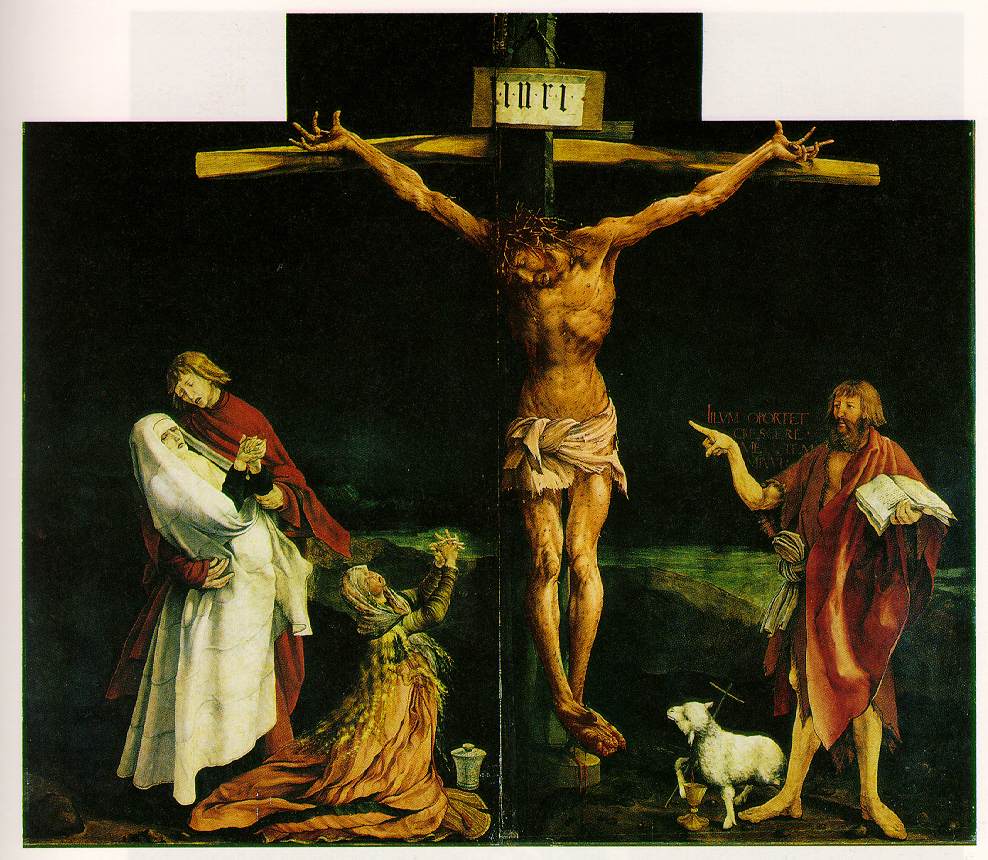

The Crucifixion, Matthias Grünewald


What difference does it make that Jesus died?

Instinctively, I know that it does make a difference that Jesus died…I just don’t know how to put into words what that difference is.  The painting is very graphic.

It isn’t like a lot of crucifixion paintings where Jesus looks more like a super-human who hasn’t been truly affected by his suffering.

No, Grünewald’s painting is very much in touch with Jesus’s human nature and what it means to suffer to the point of death.


Rather than portray God-with-us as a God who is all-powerful, Jesus is battered and grotesque and wasting away and beaten and weak at his end.

So, why does it matter that he died? First off, I think it matters because it shows that Jesus lived the entire human lifespan from birth to death.

He didn’t skip out on any aspect of it but instead lived it all.

I think what it is even more awe-inspiring in that knowledge is that he didn’t sin at all even when suffering and dying. I know for me, when I was on the brink of death I struggled to even be able to have the thought of mind to even think about sin.

My energy was spent on just surviving – the bare minimum necessary to make it through the day – so I didn’t have any extra energy to devote to loving God and others above myself.

And yet, Jesus did that. 


Another aspect that stands out to me is that if Jesus suffered and died, then there is no amount of suffering that I could go through that Jesus has not himself experienced. You could argue that his suffering was taken to completion in his death.

There is no more suffering after that point and he went there.

So, no matter how much suffering I go through, Jesus has taken it further than that because he took it to its completion.

When I was extremely sick, my body was shutting down: I was dying. Jesus knows what that is like because he was in that same place.


There is no aspect of the human life that he did not live fully.


He conquered death and that means that there is nothing that has not been conquered by him.

There is nothing that does not bow in submission to God – God reigns supreme over all including death and the depths of Hell.


My dear brothers and sisters, I pray that you will come to know Jesus, God-with-us, in ways that you never could have thought or imagined. I pray that you will rest in the knowledge that the God of the universe is with us in our lives - the good, the bad, and the ugly.

12 May 2013

mother's day and the number fifteen

Today is Mother's Day. And as much as I want to, I can't be with my mom today. Somehow 1,300 miles is a little too far to walk in a day. So, I decided to celebrate my mom by dedicating this post to her.

I know everyone makes a big deal about how their mother is the best. But I don't think it has to be a competition. I think everyone has the best mother for them. I know that is definitely true for me. God gave me the mother that I have needed, am needing, and will need.

So, I thought I would share some of the reasons why I love my mom.


15 Reasons for Why My Mother Wins at Being My Mom
1. She taught me the meaning of not letting my education get in the way of my learning.
2. She showed me that music makes everything better.

3. She has stood in solidarity with me through many different medical sagas.
4. She gave me my quirky sense of humor that finds pink flamingos, duh-winning, and Funda Hundas hilarious.
5. She knows the importance of coffee, chocolate, and ice cream.
6. She gives me advice on everything yet shows confidence in my ability to make decisions.
7. She cooks delicious gluten-free food.
8. She taught me that the number of books to get from the library is limited only to the number you can carry.
9. She taught me that sometimes characters in movies and books can seem like real humans. (And sometimes you have to go visit your "friends".)
10. She has supported me when I said I wanted to pledge a sorority, transfer to a university 1,300 miles away, and go to a Broncos game while injured.
11. She sends a lot of care packages with things like chocolate vegetables and a birthday-party-in-a-box.
12. She covers me every day and night in prayer.
13. She has taught me that Jesus needs to be the center of my life.
14. She is not simply my mom but one of my best friends.
15. She loves me unconditionally.


I love you mom! I hope that one day I can be a mom like you!

Abba, thank you for mothers. Thank you for my mother. Thank you for showing me what unconditional love looks like!